The old money sitting room is not designed to be noticed quickly. It does not seduce at first glance, nor does it rely on spectacle, novelty, or excess to assert its value. Instead, it reveals itself slowly, often imperceptibly, to those who know how to look. These rooms are built on the assumption that wealth does not need explanation. They are spaces shaped by inheritance rather than acquisition, continuity rather than consumption.
Historically, the sitting room occupied a specific role in affluent households. It was neither ceremonial nor purely private. Unlike the grand drawing room, it did not exist to impress guests, and unlike the bedroom or study, it was not a retreat from social life. The sitting room was a place of daily ritual: reading, quiet conversation, correspondence, reflection. Its furnishings were chosen for longevity and comfort, not fashion cycles. Its decor evolved gradually, absorbing decades of use, taste, and memory.
What distinguishes old money interiors from modern luxury is their relationship to time. Modern wealth often compresses status into immediacy: bold statements, visible expense, rapid transformation. Old money, by contrast, stretches meaning across generations. Objects are not replaced when trends shift; they are repaired, reupholstered, inherited. Wear is not considered damage but proof of legitimacy.
This essay explores ten distinct old money sitting room aesthetics drawn from different cultural and historical lineages. Each reflects a specific way wealth has learned to inhabit space — quietly, confidently, and without urgency. These are not prescriptive styles, but enduring atmospheres that transcend decoration.
1. English Country House Restraint
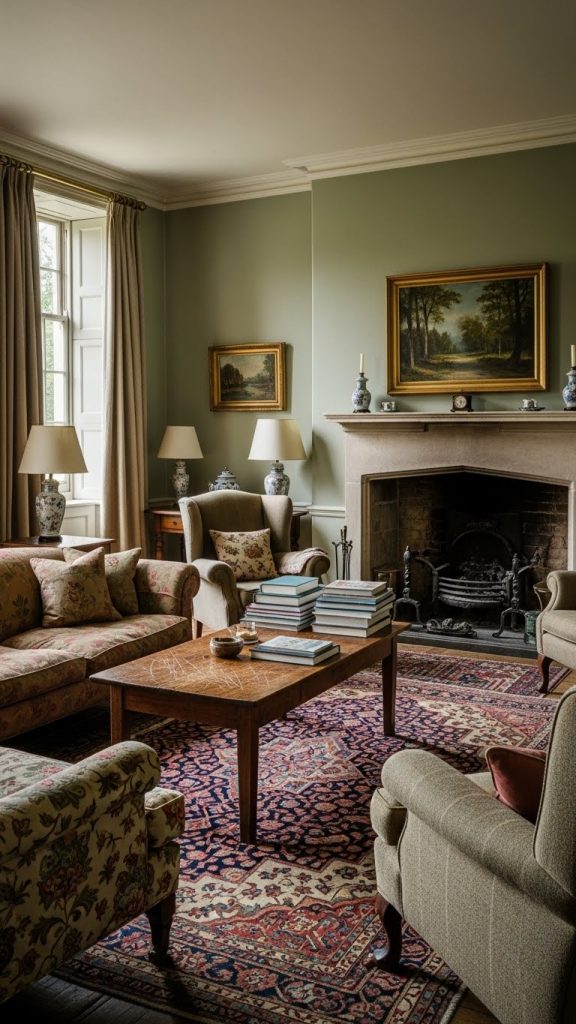
The English country house sitting room embodies the essence of old money sensibility. It is layered rather than curated, inherited rather than designed. Nothing matches perfectly, yet everything belongs.
Walls are often painted in muted heritage tones — soft sage, stone beige, weathered blue — or covered in faded floral wallpaper that has long outlived its original trend. Furniture is substantial but forgiving: deep sofas upholstered in chintz or tweed, wingback chairs with softened arms, wooden tables bearing the marks of decades of use.
The room prioritizes comfort over visual precision. Cushions are plentiful but mismatched. Books are stacked horizontally and vertically, never styled for symmetry. Lamps cast a warm, low glow through fabric shades slightly yellowed by time.
Fireplaces anchor the space, whether in use or not. Rugs overlap. Curtains hang generously, often pooling slightly on the floor. Nothing feels delicate. The room suggests long winters, inherited estates, and the quiet authority of landownership.