10 Valentines Table Decor

Of all the spaces in a home, the table holds the most emotional weight on Valentine’s Day. It is where time slows, where conversation lingers, where glances are exchanged between courses, and where intimacy becomes tangible. Unlike living rooms or bedrooms, the table is not merely inhabited — it is shared. Every object placed upon it becomes part of a silent dialogue between those seated there.

Historically, romantic meals were not rushed events. They unfolded deliberately, often by candlelight, with careful attention paid to cloth, china, and the placement of even the smallest detail. A Valentine’s table was not designed to overwhelm but to envelop — to create a sense of privacy within shared space. Romance was communicated through restraint, texture, and ritual.
Modern Valentine’s décor often leans toward excess: overly thematic colors, novelty objects, visual clutter. Vintage and timeless Valentine’s tables, by contrast, understood that romance thrives in suggestion rather than declaration. The most memorable tables are not the most decorated, but the most considered.

This essay explores ten Valentine’s table décor traditions, each rooted in a distinct cultural or emotional sensibility. These are not how-to guides, but atmospheres — ways of shaping a table so that love feels present, unforced, and enduring.

1. Candlelit Classic Romance

The most enduring Valentine’s table tradition centers on candlelight. Before electric lighting, candles were both necessity and ritual. Their presence transformed ordinary meals into intimate occasions.

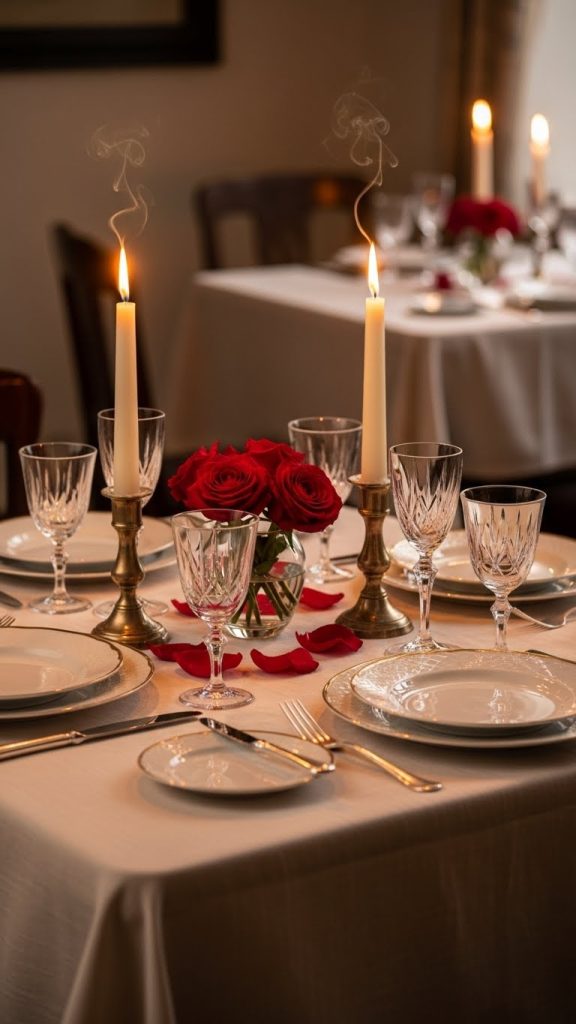
A candlelit Valentine’s table favors height variation and gentle asymmetry. Taper candles in aged holders, votives scattered thoughtfully, and occasional pillar candles create layers of light. The goal is not brightness, but glow.

Table linens are typically neutral — ivory, cream, or softly aged white — allowing the candlelight to warm the entire surface. Shadows dance across plates and glassware, softening edges and encouraging closeness.

This décor tradition frames romance as timeless. It asks diners to slow down, to linger, to notice. The table becomes a shared cocoon, sealed off from the outside world by flame and shadow.


2. Vintage Lace and Linen Elegance

Lace and linen introduce romance through texture rather than color. This Valentine’s table aesthetic draws from domestic traditions where textiles were treasured, mended, and passed down.

A lace runner layered over a linen tablecloth creates depth without clutter. The fabric’s imperfections — slight discoloration, hand-stitched edges — add authenticity. Nothing feels disposable.

Tableware is often delicate: porcelain plates, teacups repurposed for dessert, silver cutlery with softened edges. Florals remain restrained, perhaps a single arrangement of roses or seasonal blooms.

This décor tradition expresses romance as care. The table feels prepared with intention, not extravagance — a gesture rather than a display.


3. Victorian Valentine Opulence (Restrained)

Victorian Valentine tables embraced symbolism and sentimentality, but the most refined examples avoided excess. Opulence was balanced by structure.

Deep-toned linens — burgundy, antique rose, or muted crimson — ground the table. Candlesticks, often brass or silver, provide vertical rhythm. Handwritten place cards or folded notes appear at each setting.

Decorative elements may include small framed silhouettes, pressed flowers, or symbolic objects. Everything carries meaning. Nothing is arbitrary.

This tradition frames romance as emotional depth. The table feels layered, intimate, and slightly theatrical — a setting for declarations that are meant to linger.


4. French-Inspired Valentine Refinement

The French Valentine’s table favors composition over abundance. Romance is communicated through balance, proportion, and light.

Neutral table linens, simple white china, and carefully placed floral arrangements create a sense of effortless elegance. Candles are present but restrained, often grouped in odd numbers.

Glassware catches light subtly. Napkins are folded loosely rather than rigidly. The table feels inviting rather than staged.

This décor tradition reflects romance as cultivated pleasure — enjoyment rooted in taste, conversation, and shared appreciation rather than spectacle.


5. Rustic European Valentine Simplicity

In rural European traditions, Valentine’s table décor emerged from everyday materials elevated by intention. Romance was woven into practicality.

Wooden tables were often left uncovered or partially draped with runners. Earthenware dishes, simple glassware, and beeswax candles defined the setting. Fresh flowers or branches served as centerpieces.

Colors were drawn from nature: faded red, linen white, muted green. The table felt grounded and honest.

This tradition expresses romance as continuity — love integrated into daily life rather than isolated as an event.


6. 1920s Valentine Glamour (Softened)

The 1920s introduced glamour to the Valentine’s table, but in refined homes, it remained subtle. Shine was present, but controlled.

Mirrored trays, crystal glassware, and metallic accents reflected candlelight gently. Linens remained neutral, allowing highlights to emerge without overwhelming the eye.

Floral arrangements were structured but minimal. Candles were short and numerous, creating a low glow across the table surface.

This décor tradition frames romance as celebration — polished yet intimate, modern yet warm.


7. Mid-Century Valentine Nostalgia

Mid-century Valentine tables leaned into comfort and optimism. After periods of hardship, romance returned to the domestic sphere as reassurance.

Tablecloths featured subtle patterns or soft colors. Centerpieces were modest, often handmade. Place settings felt personal rather than formal.

Candles were used sparingly, supplemented by warm ambient light. The table encouraged conversation, laughter, and shared memory.

This tradition presents romance as companionship — love expressed through familiarity and ease.


8. Floral-Centered Valentine Tables

Flowers have always been central to Valentine symbolism, but the most timeless tables use them with restraint.

Rather than elaborate arrangements, vintage-inspired tables favor a few meaningful blooms placed thoughtfully. Roses, tulips, or seasonal flowers appear in low vases, allowing eye contact across the table.

Petals may be scattered sparingly. Greenery softens edges. The scent remains gentle.

This décor tradition frames romance as presence — flowers supporting the moment rather than dominating it.


9. Monochrome Valentine Tables (Soft Palette)

Monochrome Valentine tables rely on subtle variation within a single color family. Rather than bold reds, vintage palettes favor blush, cream, or antique rose.

Textural contrast becomes essential. Matte linens, glossy ceramics, reflective glass, and metallic accents interact quietly.

The effect is cohesive and calming. The table feels intentional without appearing themed.

This tradition expresses romance as harmony — many elements speaking the same language.


10. The Heirloom Valentine Table

The most emotionally resonant Valentine tables are often those built around inherited objects. Heirloom china, silver candlesticks, embroidered linens, and family glassware appear briefly, carefully handled.

Each object carries memory. The table becomes a meeting place of past and present.

Decorations are minimal. Meaning does the work.

This tradition frames romance as continuity — love not only between individuals, but across generations.


Conclusion: When the Table Becomes a Love Letter

A Valentine’s table is never just a surface. It is a stage for connection, a container for ritual, and a reflection of how love is understood within a home.

The most beautiful tables do not shout romance. They whisper it — through light, texture, proportion, and care. They allow space for conversation, for silence, for shared attention.

In choosing a Valentine’s table décor tradition, one is not selecting a style, but a philosophy. Is romance playful or solemn? Celebratory or introspective? New or inherited?

When the table is set with intention, love does not need decoration. It is already present — seated, waiting, and willing to stay.

Similar Posts

  • 10 Indoor Plant Wall Ideas for the Bedroom

    Bedrooms are meant to be sanctuaries—places where we rest, recharge, and disconnect from the outside world. In recent years, indoor plants have become an essential part of bedroom design because of their ability to soften spaces, improve well-being, and create a stronger connection to nature. Among the many ways to incorporate greenery indoors, plant walls…

  • 10 Rustic Soft Color Palettes

    Rustic decor has long been cherished for its warm textures, organic materials, and grounding atmosphere. Yet, in recent years, the rustic aesthetic has evolved into something softer, gentler, and more refined. Homeowners increasingly seek a rustic look without the heaviness traditionally associated with dark woods and bold, earthy accents. Instead, the trend has shifted toward…

  • 10 Grinch Christmas Tree Ideas

    The Grinch has become one of the most beloved holiday icons, symbolizing mischief, fun, and a playful twist on traditional Christmas decor. Whether inspired by Dr. Seuss’s classic story, the animated films, or the live-action adaptation, a Grinch-themed Christmas tree provides a whimsical and eye-catching centerpiece for holiday celebrations. These trees often combine bright colors,…

  • 10 Short Nails With Initial

    Initials are among the most powerful symbols we use. A single letter can represent a name, a memory, a relationship, or an identity. It carries meaning that is instantly understood by the wearer, yet often invisible to others. When initials are incorporated into nail design — especially on short nails — they become a quiet…

  • 10 Boho Rope Wall Art Ideas

    Boho-inspired interiors celebrate texture, natural materials, and artisanal craftsmanship. Among the many decor elements that embody this aesthetic, rope wall art stands out for its tactile appeal and versatility. Using simple cords, ropes, and knots, you can create intricate designs that transform plain walls into focal points, adding warmth and personality to any room. Rope…

  • 10 Half Bath Wallpaper Ideas

    Designing a half bath presents an interesting challenge. It is one of the smallest spaces in the home, yet it receives frequent use from both residents and guests. Because of its compact size, every design choice has an outsized impact, and wallpaper becomes one of the most powerful tools for transforming the room. It introduces…